

India and Australia have signed a Mutual Recognition Arrangement (MRA) for Organic Products on 24 September 2025 at Vanijya Bhavan, New Delhi, marking a significant milestone in strengthening bilateral trade and strategic partnership under the India–Australia Economic Cooperation and Trade Agreement (ECTA).
The Arrangement was signed in the presence of Sunil Barthwal, Secretary, Commerce, Abhishek Dev, Chairman, APEDA, and Tom Black, First Assistant Secretary, Department of Agriculture, Fisheries and Forestry (DAFF), Government of Australia. The signing was witnessed by Petal Dhillon, Joint Secretary, Department of Commerce, Alka Rao, Advisor Standards, FSSAI, and Nick McCaffrey, Australia’s Deputy High Commissioner to India, along with senior officials from the Department of Commerce and leading organic exporters.
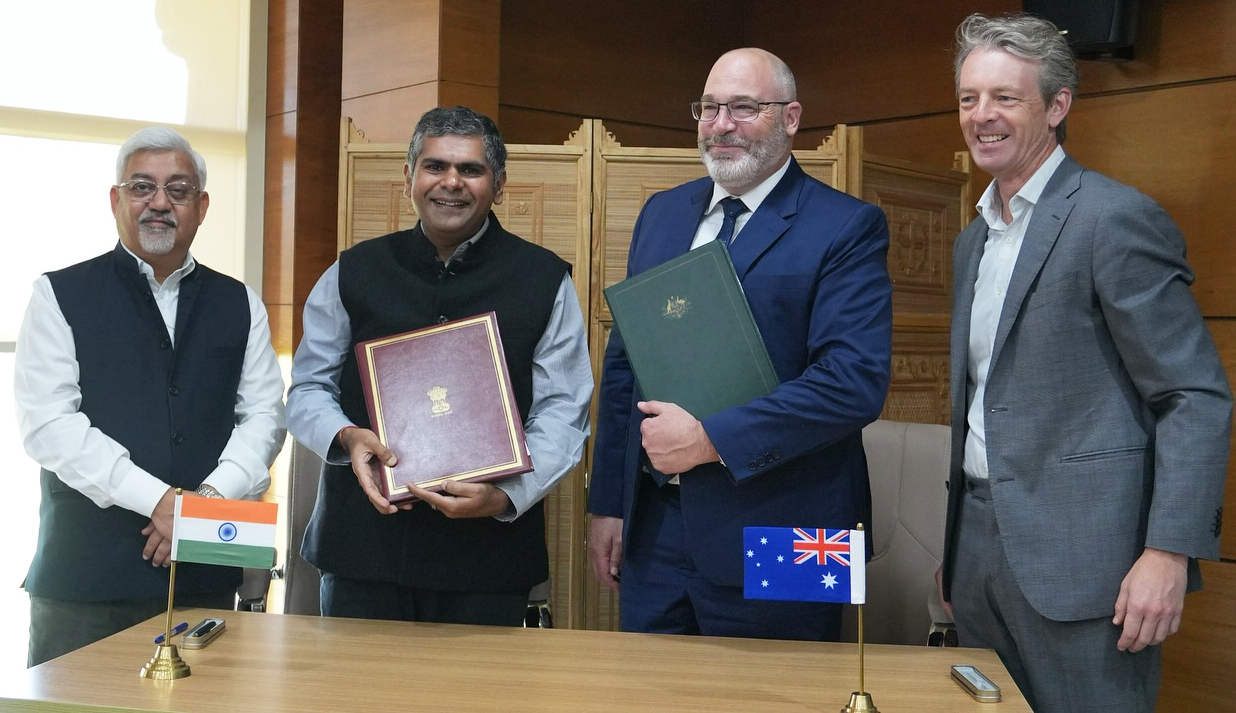
The implementing agencies for the Arrangement are the Agricultural and Processed Food Products Export Development Authority (APEDA), Ministry of Commerce & Industry, India, and the Department of Agriculture, Fisheries and Forestry (DAFF), Government of Australia.
The MRA covers organic products grown and processed within the jurisdictions of both participants, including:
- Unprocessed plant products, excluding seaweed, aquatic plants, and greenhouse crops;
- Processed foods composed of one or more certified organic ingredients of plant origin, including those sourced from third countries that meet domestic regulatory standards, provided they are processed in either India or Australia; and
- Wine.
This Arrangement reflects mutual trust and recognition of each other’s organic standards and certification systems. It will simplify compliance requirements, enhance market access, and create new opportunities for farmers and exporters on both sides.
In his address, Secretary Commerce, Sunil Barthwal, underscored the pivotal role of India’s National Programme for Organic Production (NPOP) in maintaining transparency, integrity, and credibility across the organic ecosystem. He emphasized that organic certification represents a holistic system ensuring authenticity, quality, and fair farmer income, noting that organic produce often commands 30–40% higher prices, thereby improving livelihoods.
He also highlighted the importance of labelling, penalties, and regulatory oversight to maintain strict separation between organic and non-organic produce, while advocating for enhanced training, capacity building, and advisory support for farmers. “Organic products must not be so-called organic but certified organic, with every stakeholder in the chain taking pride in maintaining that integrity,” he stated.
Tom Black, First Assistant Secretary, DAFF, lauded India’s rapidly expanding organic sector and acknowledged the contribution of the Indian diaspora in strengthening organic trade between the two nations. He noted that Australia, with 53 million hectares of organic farmland, offers vast trade potential in cereals, tea, spices, beverages, and wines.
India’s organic exports to Australia stood at USD 8.96 million in FY 2024–25, with a total export volume of 2,781.58 metric tonnes, led by psyllium husk, coconut milk, and rice.
The Government of India remains committed to positioning the country as the “Organic Food Basket of the World.” The signing of this MRA is a major step in that direction, expected to further boost organic exports by reducing trade barriers, ensuring certification equivalence, and enabling wider market access for organic producers and exporters.